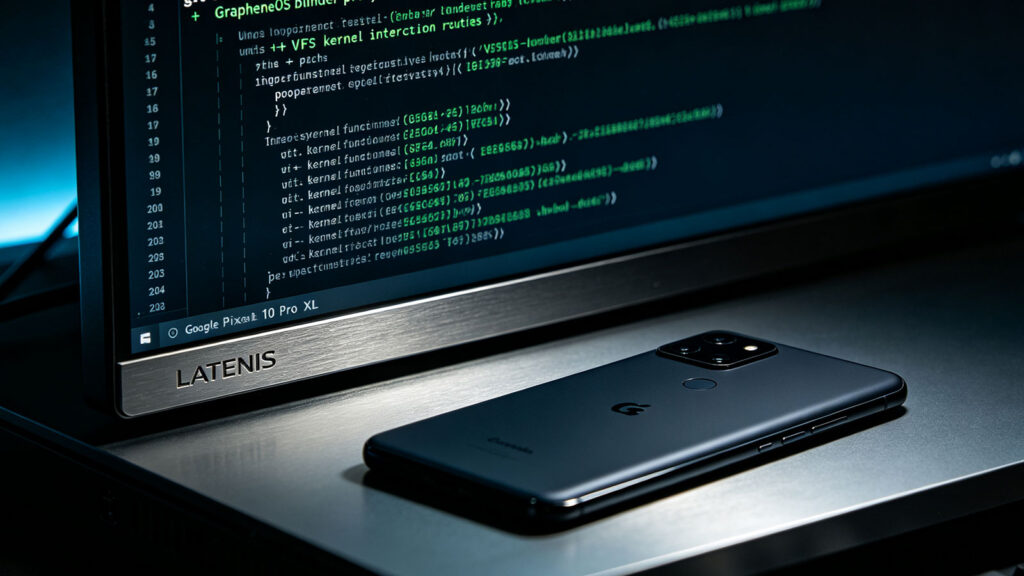

GrapheneOS security just pulled a brilliant structural defense maneuver by deleting a single legacy firmware configuration file.
They permanently removed ueventd.gs101.rc from the Tensor GS101 (Pixel 6 series) codebase. That is the entire story. To the average user, it looks like a nothing-burger GitHub commit. To anyone who actually understands low-level Android forensics, it is a textbook example of real defense: you don’t patch the attack surface—you obliterate it.

What the Hell Did the Developers Delete?
Let’s unpack the technical baseline without wasting time on fluff. Deep down inside the Android operating system, ueventd operates as a highly privileged background daemon. Its primary job is to listen for hardware event triggers executed directly by the Linux kernel.
When a hardware component initializes, the system parses vendor-specific .rc configuration files to dynamically spawn device nodes in the user-space and assign their respective system access permissions. This is standard operational procedure for stock devices.
However, proprietary vendor .rc files are a notorious dumpster fire of legacy code. They are cluttered with unmaintained hardware rules, abandoned debugging channels, and obsolete engineering paths that commercial OEMs regularly forget to clean up before factory packaging. They ship these liabilities directly into production devices worldwide.
For sophisticated threat actors, this unmaintained vendor cruft is an absolute goldmine. A massive percentage of high-profile Android privilege escalation chains and local kernel 0-days do not target the core operating system logic. Instead, malicious scripts exploit these poorly audited, vendor-specific hardware rules to break out of the application sandbox and grab root privileges. This structural vulnerability is precisely what compromises standard mobile architecture.
How This Elimination Changes GrapheneOS Security Baseline
The development team did not spend weeks auditing those 243 lines of inherited code. They did not attempt to refactor the configurations, nor did they try to patch individual loopholes. Instead, they took the absolute engineering approach: they deleted the whole bloody file.
This specific configuration file defined low-level system access rules for non-essential hardware sub-systems on the Pixel 6 platform. Without this file present in the OS compilation, the system simply refuses to create those underlying device nodes in the first place. The local attack surface is not merely reduced; it is completely erased from the kernel runtime environment. This aggressive reduction of inherited code paths represents the core philosophy backing true GrapheneOS security deployment models.
| Defense Vector | Stock Android Baseline | Hardened GrapheneOS Architecture |
|---|---|---|
| Vendor Code Processing | Parses all legacy rules unconditionally | Purged entirely from memory. Full stop. |
| Available Attack Surface | Exposes test channels and unmapped registers | Limited strictly to production-essential nodes |
| Sandbox Escalation Depth | One driver bug can unlock full sandbox escape | IOMMU strictly enforces sub-system isolation |
Consider the real-world defensive impact: even if an advanced threat actor successfully compromises your web browser sandbox via a remote zero-click exploit, the attack chain immediately hits a concrete wall. Because the operating system no longer generates those legacy hardware entry points, there is no unverified local rule left to abuse for lateral movement. The entire attack chain simply dies right there in user-space.
Real Technical Sovereignty Goes Beyond Cosmetic Privacy
Most commercial operating systems that market themselves as secure focus entirely on superficial cosmetic privacy features. They sell you on fancy app lockers, colorful permission toggles, or encrypted gallery folders to hide your personal data. That is security theater.
Authentic GrapheneOS security targets the bare metal beneath the glass. By auditing and deleting vendor communication protocols line by line, the OS ensures that the underlying hardware controllers cannot be subverted or weaponized against your identity by local exploit payloads.
This relentless focus on low-level mitigation is exactly why LATENIS builds our entire hardware line on top of this infrastructure. We do not do it because it is fashionable; we do it because it survives real-world penetration vectors. You can review our hardened device inventory directly at our LATENIS Hardware Provisioning Shop to secure your communication baseline.
Want to Verify the Source Code?
The open-source ledger remains entirely public. If you want to verify the commit metrics yourself, you can track the exact file removals on the official repository tracker via the link below: